
Advisory
A decision that has to hold up.
For leaders, boards, and the advisors around them. You receive an independent assessment, a decision memo or executive briefing, and the assumptions behind it stated plainly.
Eldris
Eldris is an applied AI firm. We advise leaders on consequential AI decisions, study how people actually come to use AI, and build OOMU, software that puts it to work on the Mac you already own.
Why Eldris
Eldris is led by Dr. Jeffrey Allan, who built OOMU from the ground up and directs the Institute for Responsible Technology and Artificial Intelligence at Nazareth University. Behind that sit fifteen years working in Asia, senior roles in multinational companies, two technology startup exits, and years of state and federal technology policy work.
A question about AI rarely stays technical, commercial, or political for long. The firm is built to follow it across all three.
What we do
Each one starts from a different situation and ends with something you can use.
Advisory
For leaders, boards, and the advisors around them. You receive an independent assessment, a decision memo or executive briefing, and the assumptions behind it stated plainly.
Research
Original studies of how people and organizations come to use AI, commissioned for your question or licensed for internal use.
OOMU®
A native Mac app, free to use, including at work. For organizations, OOMU Control governs it centrally, and we can help with setup, workflow design, and training.
Eldris research is organized in two programs. The Enterprise AI Adoption Gap looks at people inside organizations, where roles, incentives, accountability, and coordination shape what gets used. The Consumer AI Adoption Gap looks at individuals, whose circumstances and tasks differ from one person to the next.
Each program is a series of bounded studies, and each study defines a decision, a population, a task, and a boundary before any fieldwork begins.
Illustrative question, not a finalized study
What keeps an employee who has access to AI from using it for a particular work task?
Senior-led and team-backed. Our assessment follows the evidence, including when it does not support the preferred direction.
OOMU in use
You ask in your own words. For each request, OOMU decides on your Mac whether the Mac or a cloud model should answer, within the same chat, without you switching models.
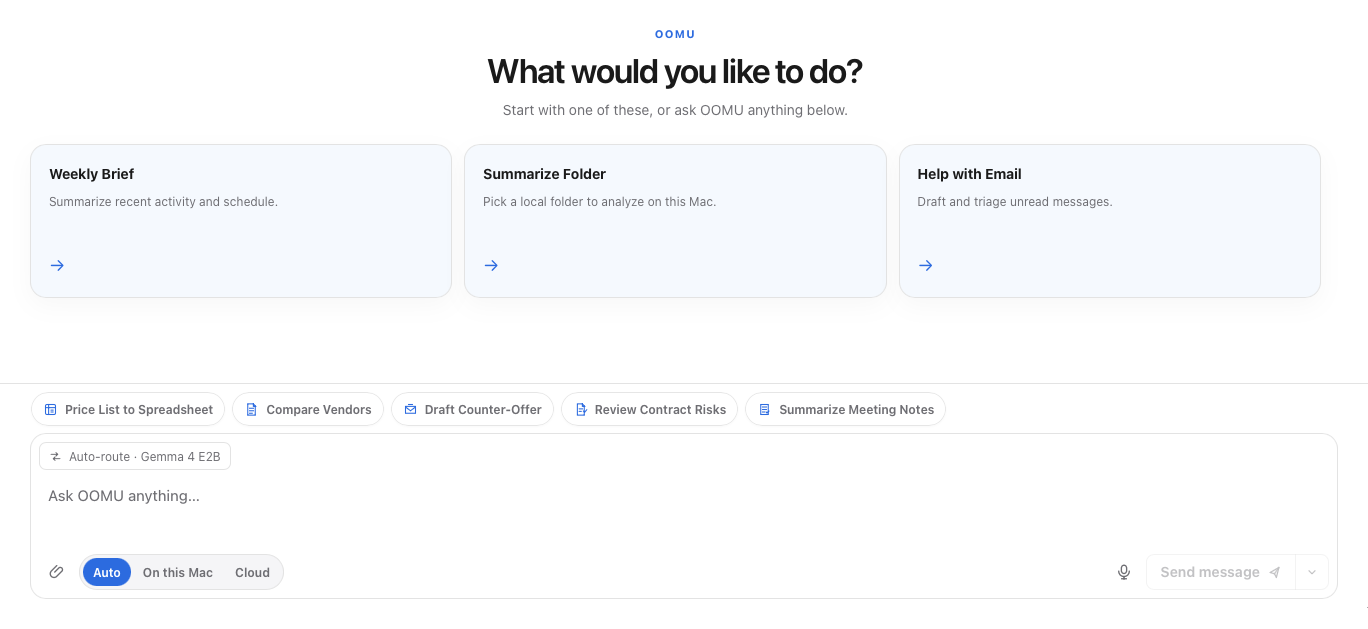
The app
The whole app, for commercial use too. Everyday work runs on your Mac with no charge per question. Optional cloud models are billed by the provider you choose.
OOMU Control
The server an organization runs to deploy OOMU, decide which models every Mac may use, and see what each one is running and what it blocked.
Implementation
Setup, workflow design, and training for a team putting OOMU to work, agreed in writing before it starts.
Pick the closest route. A short description is enough to start, and we can define the scope together.