
Executive brief
An organization provides AI tools. Some employees experiment, others use them regularly, and some avoid them. Which response should management choose: better access, more training, clearer rules, a different workflow or a narrower deployment?
The answer depends on what prevents a useful result. An employee may lack permission, see little relevance to the job, struggle to verify an output, or believe that the expected benefit comes with personal costs. These explanations imply different business decisions. Calling all of them resistance obscures the problem management needs to solve.
This report is for enterprise AI leaders, operating executives and people leaders deciding how to support a defined employee workflow. Its central recommendation is to make the employee's working conditions and the accepted work outcome, rather than tool activity alone, the unit of adoption planning.
Three principles follow:
- Diagnose before intervening. Low use does not identify a training problem. High use does not establish useful or authorized work.
- Make responsibility workable. Give employees the time, information, authority and support needed to meet the standards for which they are accountable.
- Measure the whole result. Include reviewers, downstream teams, exceptions and employee experience when assessing a deployment.
Employee participation is a source of operational evidence. The people completing the work can identify where an assistant saves effort, where it creates correction work and where the approved process fails in practice. Their observations should inform a decision that management can actually take.
The business objective is sustained, acceptable work at a justified cost. A team that uses AI selectively and delivers that result may be more successful than one that achieves a high usage target without improving the work.
What employee adoption numbers reveal
Gallup's Q2 2026 findings report that 52% of U.S. workers use AI in their role, 30% use it frequently and 15% use it daily. Frequent means a few times a week or more. These are overlapping frequency measures, not separate market segments or stages in a conversion funnel. Gallup's July 20, 2026 release.
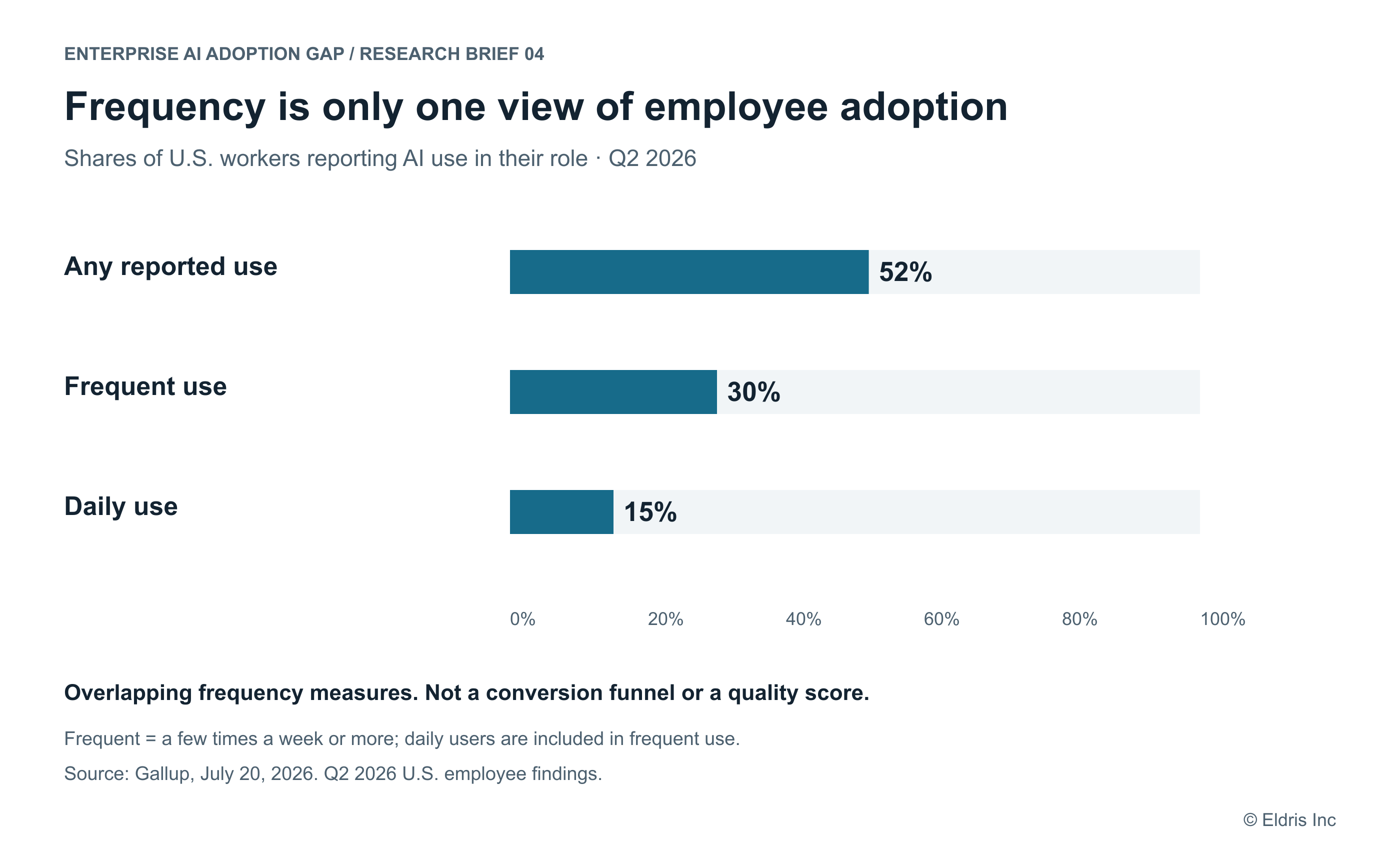
Figure 1. Frequency does not establish a successful deployment. Published employee reports of AI use. Frequent and daily users are included within broader use; do not add the percentages. The measures do not identify approved tools, accepted outcomes or realized business value.
For an enterprise, the relevant denominator is usually narrower: employees eligible to complete a particular task, with the required access and permission. A weekly usage target has little meaning for a task that occurs once a month. An employee may also use several assistants while the approved workflow remains unchanged.
Begin with the actual work. For example, consider a customer-support team using an assistant to prepare responses to billing questions. Define eligible cases, approved data, required checks, escalation rules and the point at which the response is accepted. Then ask where employees encounter difficulty.
That definition makes the next decision concrete. If eligible employees cannot access the approved system, address access. If they can access it but its outputs require more effort than the existing process, investigate performance and workflow fit. If the process works but employees misunderstand the permitted use, clarify the rule and test comprehension.
Management implication: A usage dashboard should locate a question to investigate. It should not prescribe training, pressure or license expansion by itself.
Manager support and workflow fit deserve separate tests
In Gallup's February 2026 survey of 23,717 U.S. employees, frequent use among employees in AI-available organizations differed by strong agreement with manager support (78% versus 44%) and workflow fit (88% versus 55%). The comparison groups did not strongly agree. Gallup's April 12, 2026 analysis.
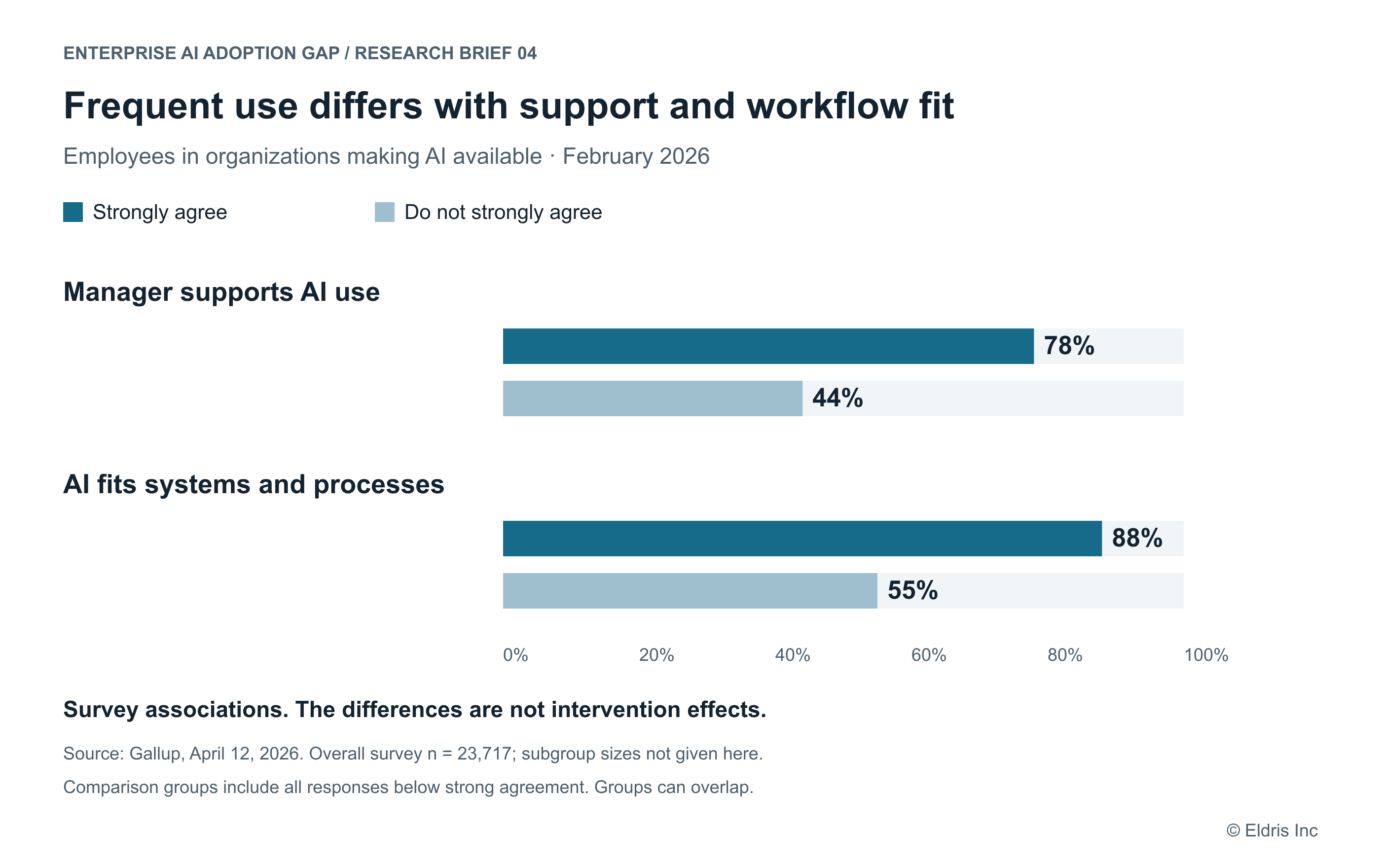
Figure 2. Support and workflow fit are associated with frequent use. Each pair compares strong agreement with all other responses. Groups can overlap across conditions. These are observational comparisons, not intervention effects.
These comparisons suggest interventions worth evaluating. They do not show that a manager campaign will produce a 34-percentage-point increase, or that integration will produce a 33-point increase. Employees who already use AI may judge support more favorably; task characteristics and organizational resources may influence both.
Support should therefore be specified as an operating practice. In the billing-response example, a manager could provide time to learn, explain acceptable uses, review difficult cases and resolve disputes about when to escalate. Merely expressing enthusiasm leaves the employee to determine those boundaries alone.
Workflow fit is a different intervention. It might involve access to the relevant approved information, fewer transfers between systems or a clearer handoff to the person who accepts the result. A confident manager cannot compensate for an assistant that lacks essential context or makes verification impractical.
Management implication: Test the support practice and the workflow change that leadership can fund. Measure accepted outcomes and effort as well as frequency. Do not treat a survey association as a return-on-investment estimate.
Diagnose the obstacle before buying the remedy
The following map is an Eldris organizing framework. It is not a validated maturity model or a claim about the prevalence of each obstacle.
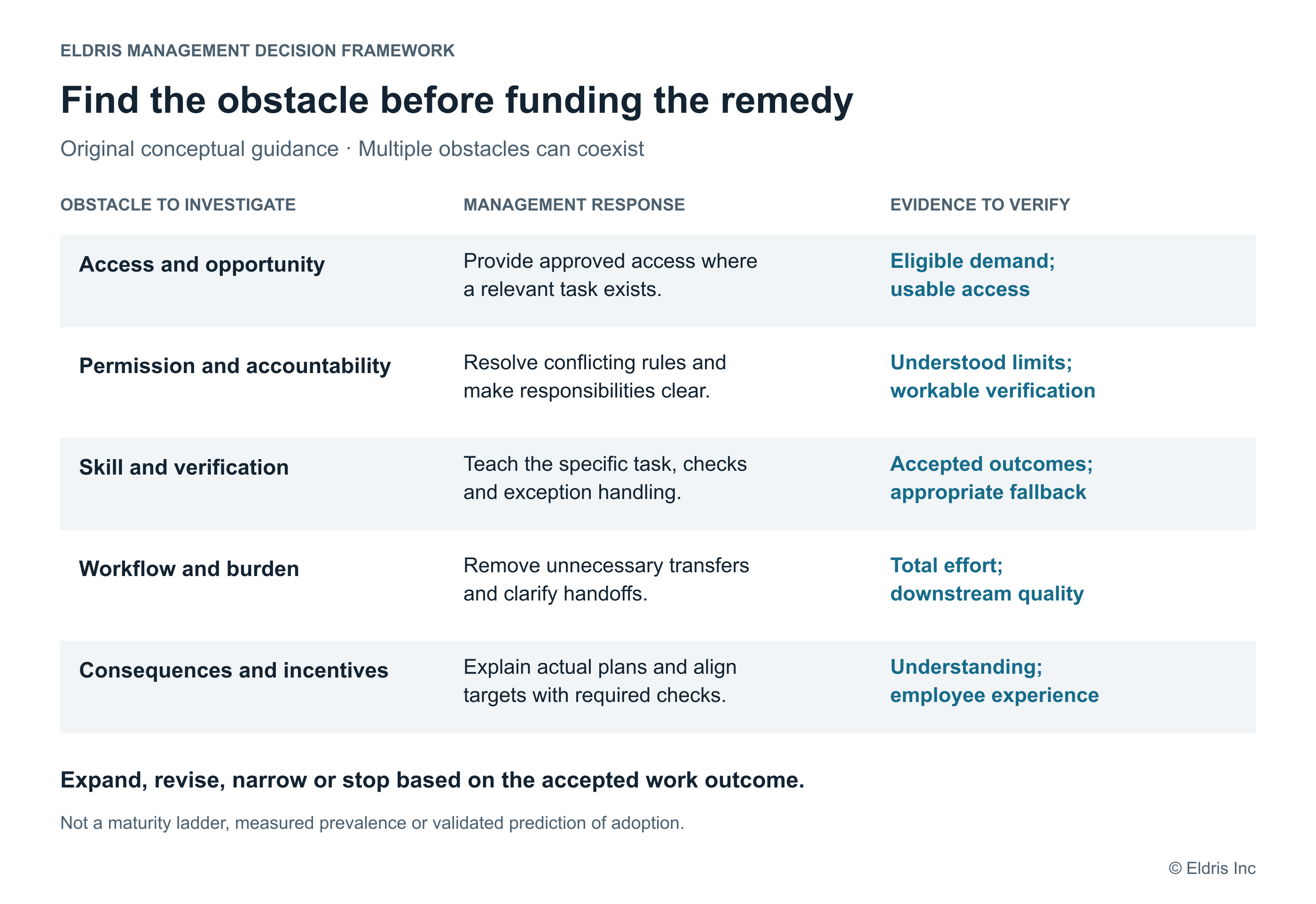
Figure 3. Different obstacles require different management actions. Original conceptual guidance. An employee can face several obstacles at once, and evidence may support narrowing or stopping a use case.
Access and opportunity. Determine whether the employee has an approved tool, the relevant data and a real opportunity to use it. Lack of activity without an eligible task is not an adoption failure. Provisioning more seats will not resolve a lack of useful tasks.
Permission and accountability. Ask whether employees can correctly explain permitted data, required checks and when to stop. A policy exists operationally only if people can apply it. If managers give conflicting instructions, resolve the conflict before attributing nonuse to employee attitudes.
Skill and verification. Training should prepare employees to recognize when the assistant is useful, detect relevant errors and route difficult cases. A prompt-writing course does not establish these abilities. Evaluate actual task performance after training, including justified rejection of an output.
Workflow and burden. Observe the work around the assistant. Does the employee re-enter information, reconcile inconsistent answers or wait for someone else's approval? Include those costs. A faster first response can still increase reviewer effort or create more reopened cases.
Consequences and incentives. Ask what employees believe will happen if they disclose an error, save time or refuse an inappropriate use. Those beliefs may be accurate, mistaken or mixed. Establish the actual management decision before attempting to change perceptions.
These categories should generate evidence questions rather than labels for people. “Low-confidence worker” is less actionable than “cannot verify whether the proposed billing adjustment is correct with the information available.” The latter points to a change in information, process or authority.
Management implication: Allocate spending to the demonstrated obstacle. Preserve the option of narrowing the task when useful performance is not achievable under acceptable conditions.
Frequent use does not mean employees feel secure
A September 9, 2026 Gallup analysis of four U.S. workforce survey waves from 2023 through early 2026 reports that frequent AI users were more than twice as likely as less frequent users to report acute concern about job elimination in most waves. It also describes associations between supportive workplace conditions and lower concern. Gallup's longitudinal analysis.
This is evidence that frequent use and concern can coexist. It is not proof that AI use causes job anxiety or that reassurance prevents displacement. Repeated observations and statistical controls improve the analysis but do not eliminate every changing influence on employees' experiences.
Leadership should distinguish concerns about the tool from concerns about the employment relationship. “Will this response be accurate?” and “Will my role change if I demonstrate that this work can be automated?” require different answers.
A credible rollout should state the intended benefit, how work will change, how performance will be assessed and what decisions remain unresolved. If staffing changes are part of the objective, a generic message about empowerment is inadequate. If the aim is faster service, identify how released capacity will serve that objective and what it means for the team.
Avoid promises the organization cannot support. Employees need an honest account of known plans and uncertainty, together with a way to raise practical concerns. Measure whether that account is understood; do not equate attendance at a briefing with agreement or confidence.
Management implication: Track employee experience alongside use and performance. Rising activity can accompany unresolved concern, greater burden or a loss of confidence in management.
Make accountability possible in the actual workflow
An employee who must approve AI-assisted work needs a realistic way to evaluate it. “A human remains responsible” is not a complete operating design.
For the billing-response example, specify what the assistant may prepare, what the employee must verify, what information supports that verification, and who handles an exception. If the employee cannot inspect a calculation or obtain a source record, assigning responsibility does not create the ability to exercise it.
Set aside time for the required review. Identify the authority to reject an output and the alternative process when the assistant fails. Check whether production targets allow employees to follow these instructions. A formal review requirement paired with a target that makes review impractical creates an operating conflict.
Give feedback a route to action. Record the type of problem, its effect on the work and the person responsible for resolving it. An error-reporting channel without an owner leaves the burden with the employee. Where reporting is used for improvement, explain its purpose and how it differs from individual performance assessment.
Use task measures with care. Prompt counts or time in an application do not establish diligence, capability or productivity. Monitoring should answer a defined operational question, with the purpose and handling of employee data made clear. Collect the information needed to evaluate the workflow rather than treating all available activity as meaningful evidence.
Management implication: Before expanding scope, demonstrate that employees can carry out the responsibilities the deployment assigns to them under ordinary working conditions.
Individual benefit and team benefit need different evidence
Dillon and colleagues studied randomized access to an integrated generative AI tool across 66 firms and 7,137 knowledge workers. In the second half of the six-month experiment, the 80% of assigned-access workers who used the tool spent two fewer hours on email per week and reduced work outside regular hours. The researchers did not detect changes in task quantity or composition from individual AI provision. NBER paper, revised November 2025.
The two-hour finding concerns tool users in that experiment, not every assigned worker or a guaranteed benefit for another workforce. Failure to detect a broader change also does not establish that no other benefit exists.
The practical distinction is important: an employee can experience a useful improvement while coordination, approval or demand limits the team's result. A rollout assessment must be capable of detecting both.
In support work, measure the initial response and the accepted resolution. Include review time, handoffs, reopened cases and support provided to colleagues. Examine whether easier tasks improve while difficult cases concentrate on a smaller group. Report workload distribution as well as average effort.
Choose the benefit management intends to realize: better service, additional accepted output, improved quality, reduced expenditure or a more sustainable workload. Each needs its own evidence. Do not count the same released time as both cash savings and additional production without reconciling how capacity is allocated.
Management implication: Scale on the demonstrated benefit across the workflow. Employee time savings are informative, but they do not automatically establish team output or financial return.
What evidence should change the rollout decision?
Define a bounded decision before launching employee research. For example: should one support unit introduce an assistant for a specified class of billing questions, and should it receive task-based coaching, a revised approval process or both?
| Decision | Evidence needed | Action supported |
|---|---|---|
| Expand approved access | Useful eligible demand and a demonstrated access constraint | Provision the tool where the task warrants it |
| Invest in training | A skill or verification gap that practical support can address | Teach the specific capability and test it |
| Redesign the workflow | Avoidable transfers, review burden or unclear handoffs | Change the process and compare outcomes |
| Clarify operating rules | Misunderstood permission or conflicting expectations | Resolve the rule and verify comprehension |
| Expand or narrow deployment | Sustained accepted outcomes, costs and employee experience | Expand, retain, revise or stop the defined use |
Combine confidential employee accounts with observation of the work and appropriate operational records. Include nonusers, occasional users, regular users, reviewers and managers. A study of volunteers who already like AI cannot establish the needs of the whole eligible team.
Where feasible, compare implemented alternatives through randomized assignment or a credible phased rollout. Account for shared work, learning and spillovers when selecting the unit of assignment. Hold tool capability and task scope comparable when testing a support intervention. If training and software both change, the result concerns the combined package unless the design separates them.
Specify outcome standards before examining results. Record assignment, actual use, completion, attrition, costs, incidents and justified fallback. A successful intervention should improve the intended result under acceptable conditions, not merely increase activity.
An external participant panel can help compare task instructions or accountability scenarios for a defined worker population. It cannot establish the behavior of a particular enterprise's workforce, its actual review burden or sustained use without evidence from that setting. Scenario choices and controlled task performance should remain labeled as such.
The report's recommendation is to replace a generic adoption campaign with a documented intervention decision: the obstacle observed, the change proposed, the result required and the evidence that would justify expansion. That makes employee research useful to the people controlling budgets and operating processes.
Method and limitations
This brief selectively reviews primary public research checked on October 3, 2026. It is not an original employee study, systematic review, pooled estimate or analysis of respondent-level data. It does not identify a universally effective rollout strategy.
The Gallup findings concern U.S. employees, with distinct periods and analytic populations. The Q2 frequency snapshot and February support comparisons should not be combined into one funnel. Survey associations do not establish the effect of a management intervention. The source releases do not provide subgroup sample sizes or uncertainty estimates for every comparison reproduced here; no significance claims are made for the plotted differences.
The NBER study concerns knowledge workers and a particular integrated tool. Some authors worked for Microsoft, the provider; the paper discloses that authors retained discretion over results. The reported experiment does not establish the outcome of other tools, tasks or workforce conditions. Gallup sells workplace research and advisory services; its recommendations are considered alongside its commercial context.
Multinational enterprises should evaluate task scope, language, data access, managerial authority and local operating arrangements before applying U.S. employee findings elsewhere. Nationality or age alone is not an explanation of adoption behavior. This report's diagnosis, examples and recommendations are Eldris interpretations that require validation in the target workflow.
All figures distinguish published survey measures from original conceptual guidance. No proprietary employee data, simulated observations or forecast of enterprise return is presented.
Sources
- Gallup. Organizational AI Adoption Jumps Six Points. Andy Kemp, July 20, 2026. Q2 2026 U.S. employee findings; reported AI-use frequency, not approved use or outcome quality. Research release.
- Gallup. AI in the Workplace: What Separates Adopters and Holdouts. Andy Kemp, April 12, 2026. February 2026 survey of 23,717 U.S. employees. The plotted comparisons concern employees in organizations making AI available; 23,717 is the overall sample, not each subgroup's size. Analysis and comparisons.
- Gallup. Using AI More Does Not Reassure Workers, Managers Do. Christos Makridis, September 9, 2026. Four U.S. workforce survey waves from 2023 through Q1 2026; longitudinal and observational analysis of displacement concern and workplace conditions. Analysis.
- Dillon, E. W., Jaffe, S., Immorlica, N., and Stanton, C. T. Shifting Work Patterns with Generative AI. NBER Working Paper 33795, May 2025, revised November 2025. Randomized access across 66 firms and 7,137 knowledge workers; the cited email result concerns users among those assigned access in the experiment's second half. Paper and disclosures.