
Apple Made Local AI a Software Decision
Apple silicon and unified memory made meaningful local model deployment practical inside a personal computer. That change enabled OOMU, and deserves a larger place in enterprise AI strategy.
Commentary
An AI system can generate work faster than an organization can responsibly approve it. Leaders who promise human oversight need to fund and test the capacity behind that promise.
Imagine an AI system that prepares recommendations for account managers. During the pilot, a small group checks each recommendation carefully. The outputs look useful, and the team proposes deployment across the business.
Then the volume increases. The recommendations arrive faster than the experienced reviewers can check them. Some wait. Some receive a shorter review. Employees start treating an approval as a way to clear the queue.
This is a hypothetical scenario. It illustrates a question that should be central to any deployment with a review requirement: can the organization perform the review it has promised at the volume it intends to produce?
My position is that “a human will review it” is an incomplete operating proposal. It names a control without establishing its capacity, effectiveness or cost. A leader who accepts it as sufficient assurance is authorizing a dependency the business has not yet explained.
An AI service may generate another recommendation at relatively low incremental cost. An informed reviewer needs time, attention, relevant information and authority.
Those resources do not expand merely because the system becomes faster. If deployment increases the number of items requiring approval, management must decide whether to add reviewers, narrow the workload, improve the review process or change the scope of automation.
The queue makes those choices visible. A delay can be the consequence of a control functioning as intended: the business refuses to act until someone qualified checks the work. Shortening that delay by weakening the check changes the operating arrangement.
The decision deserves to be explicit. Otherwise, the project can retain the language of careful oversight while quietly operating with a different level of scrutiny.
An approval button is easy to deploy. The judgment behind it needs a capacity plan.
A recommendation that looks plausible can still require substantial work to verify. The reviewer may need to retrieve a record, check an exception, reconcile conflicting information or understand the consequence of acting.
A fluent explanation can help. It can also make an answer easier to accept before the underlying evidence has been examined. The operating team should establish what a good check actually involves, rather than assuming that reading the output completes the task.
NIST’s AI Risk Management Framework places defined human-AI roles and oversight under GOVERN 3.2. That supports assigning responsibilities. The business still has to establish whether those responsibilities can be carried out effectively in its setting. NIST AI RMF Core.
A commercial evaluation should include the time spent on approval, corrections and exceptions. If the system saves preparation time but adds an equally demanding verification task, the organization needs to know. If it produces better outcomes despite additional review, that may justify the investment. Either result deserves an honest account.
The meaningful unit is the completed business action at an acceptable quality level. Generation speed alone cannot establish that unit’s cost.
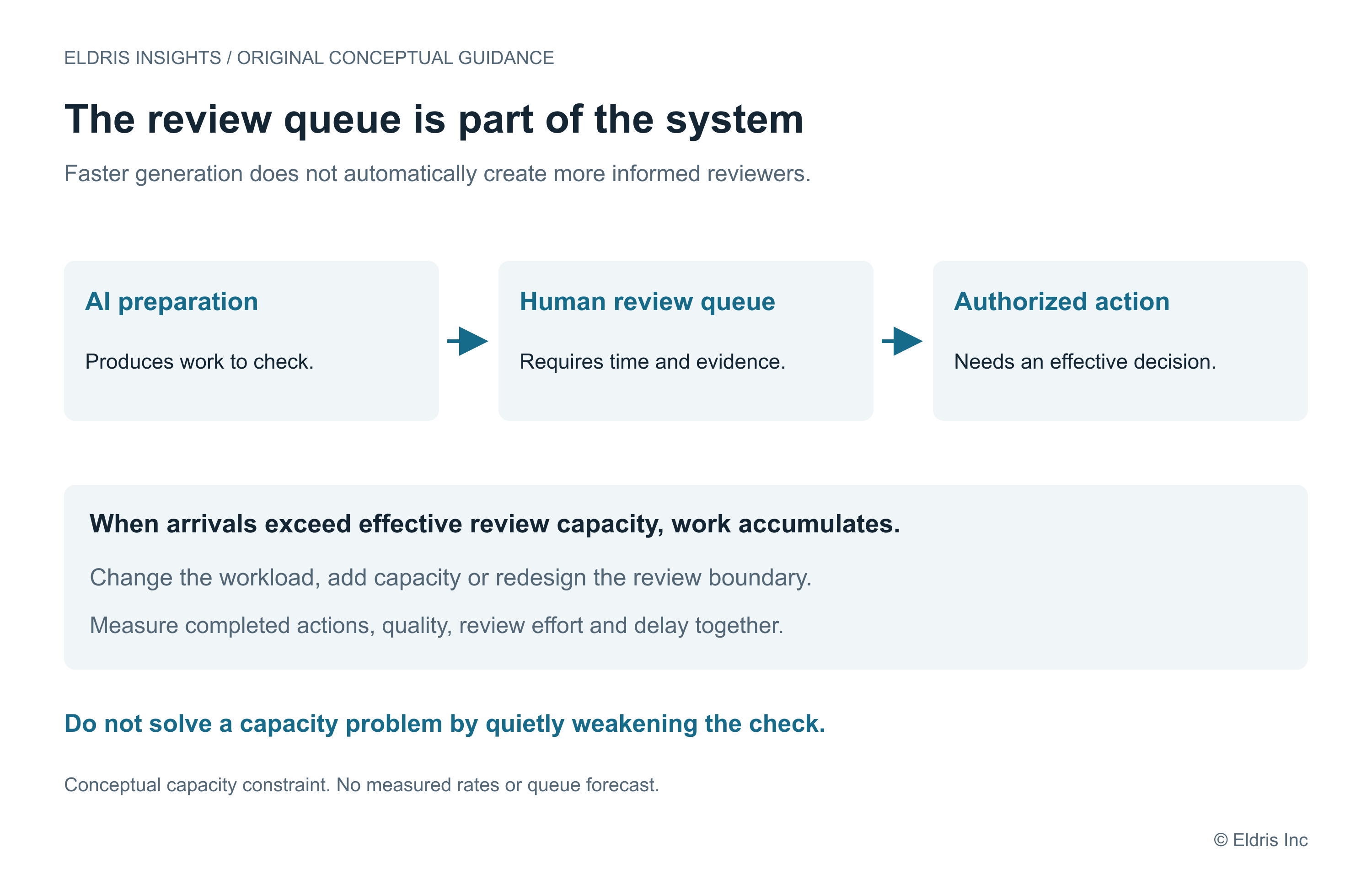
Original Eldris conceptual guidance. The queue illustrates a capacity constraint, not measured rates or a forecast. Review effort can vary substantially by case.
The strongest objection is that requiring review for everything prevents organizations from realizing AI’s potential. A capable system should sometimes be allowed to act within established limits.
I agree. Review should be proportionate to the action, the quality of the available evidence and the consequences of an error. A low-consequence, readily reversible action may justify a different approach from a commitment that is difficult to undo.
But management must justify that design through evaluation. Removing a check because the queue has become inconvenient is different from establishing that the check is unnecessary for a defined category of work.
A better design might allow bounded actions without individual approval, require review for specified exceptions and audit a sample of routine cases. Such a design needs evidence about how exceptions are identified and which errors sampling could miss. A sampling policy is a choice about what the business may learn after an action, not a substitute for checking a critical decision beforehand.
Another good answer may be a narrower service. The system could prepare information while leaving the consequential judgment to an employee. The objective should be a useful operating arrangement, with an explicit reason for each review boundary.
Before expansion, measure the complete review task on representative cases. Include the difficult cases that require more time and the conditions under which qualified reviewers are unavailable. A calm demonstration with experts standing by is a weak test of capacity during peak demand.
Specify what happens when work accumulates. Does the system slow intake? Does the action wait? Does an alternative process take over? Establish who can make that choice and which commitments to customers are affected.
Monitor the quality of review as well as its speed. A short approval time could mean the interface is excellent. It could also mean people are barely checking. The business needs evidence that helps distinguish those possibilities.
For a multinational deployment, confirm that each receiving team has the records, skills and authority the review requires. The same approval screen can conceal very different operating capabilities.
An executive should expect the proposed owner to answer three connected questions: what requires review, what makes the review effective and how the business supplies enough of it. Those answers belong in the deployment case and its budget.
If the business cannot scale the judgment it requires, it cannot scale the service it has approved. Build that constraint into the strategy before the queue makes the decision for you.
More insights
Apple silicon and unified memory made meaningful local model deployment practical inside a personal computer. That change enabled OOMU, and deserves a larger place in enterprise AI strategy.
A provider's attractive inference price can conceal an expensive dependency. Enterprise buyers should make the ability to change providers part of the original investment decision.
An assistant that presents itself as working for the customer should make commercial influence visible and let the customer define what a good purchase means.
The writing is the general case. An advisory engagement is the specific one.