
Apple Made Local AI a Software Decision
Apple silicon and unified memory made meaningful local model deployment practical inside a personal computer. That change enabled OOMU, and deserves a larger place in enterprise AI strategy.
Commentary
A provider's attractive inference price can conceal an expensive dependency. Enterprise buyers should make the ability to change providers part of the original investment decision.
Imagine an enterprise choosing an AI provider. The model performs well, the unit price is competitive and the integration appears straightforward.
A year later, management wants to evaluate an alternative. The team discovers that replacing the model means revisiting tool behavior, permissions, retrieval, prompts and the tests used to approve outputs. Several workflows now depend on features specific to the original service.
This is a hypothetical case. The lesson is that the cost of an AI relationship includes the work required to change it.
My position is that buyers should assess their exit options before expanding a provider’s role in the business. They need a credible account of what can move, what must be rebuilt and how they would establish that the replacement still performs the work acceptably.
If you have never tested what it takes to leave, the provider’s price is only part of the price you know.
An integration layer can make it easier to send requests to different models. That is useful engineering. It does not establish that the models behave interchangeably.
A replacement may interpret instructions differently, produce different structured outputs or choose tools in different ways. Even when the surrounding application still runs, the workflow may need to be evaluated again.
The same applies to services around the model. Stored state, search, file processing and provider-specific features can become part of the application’s operating behavior. Moving a prompt is easier than moving a service the business relies on.
This does not make portability an illusion. It means buyers should describe it precisely. Is the request interface portable? The data? The workflow? The measured outcome? Each answer requires different evidence.
A purchasing team should be suspicious of a claim that switching is easy when the evidence consists only of a successful response from another endpoint. The task is to preserve acceptable business behavior under the new arrangement.
Replacing a provider is harder to assess when the organization lacks its own account of what good performance looks like.
The business should retain representative evaluation cases, approved success criteria and the information needed to investigate failures. Those materials help it judge a new model without depending entirely on either provider’s sales claims.
They also help diagnose change within the existing relationship. A service update can require attention even when the invoice and brand stay the same. An evaluation process should be able to detect material changes in the outcome the organization cares about.
NIST’s AI Risk Management Framework includes third-party risk management under GOVERN 6 and safe decommissioning under GOVERN 1.7. My commercial interpretation is that a serious provider assessment should include how the business will manage replacement and withdrawal, as well as adoption. NIST AI RMF Core.
The exit plan should establish what the customer can export, what records it must retain and which dependencies would survive a provider change. It should also identify the team and resources required to make the transition. A right written into a contract has limited practical value if nobody can execute it.
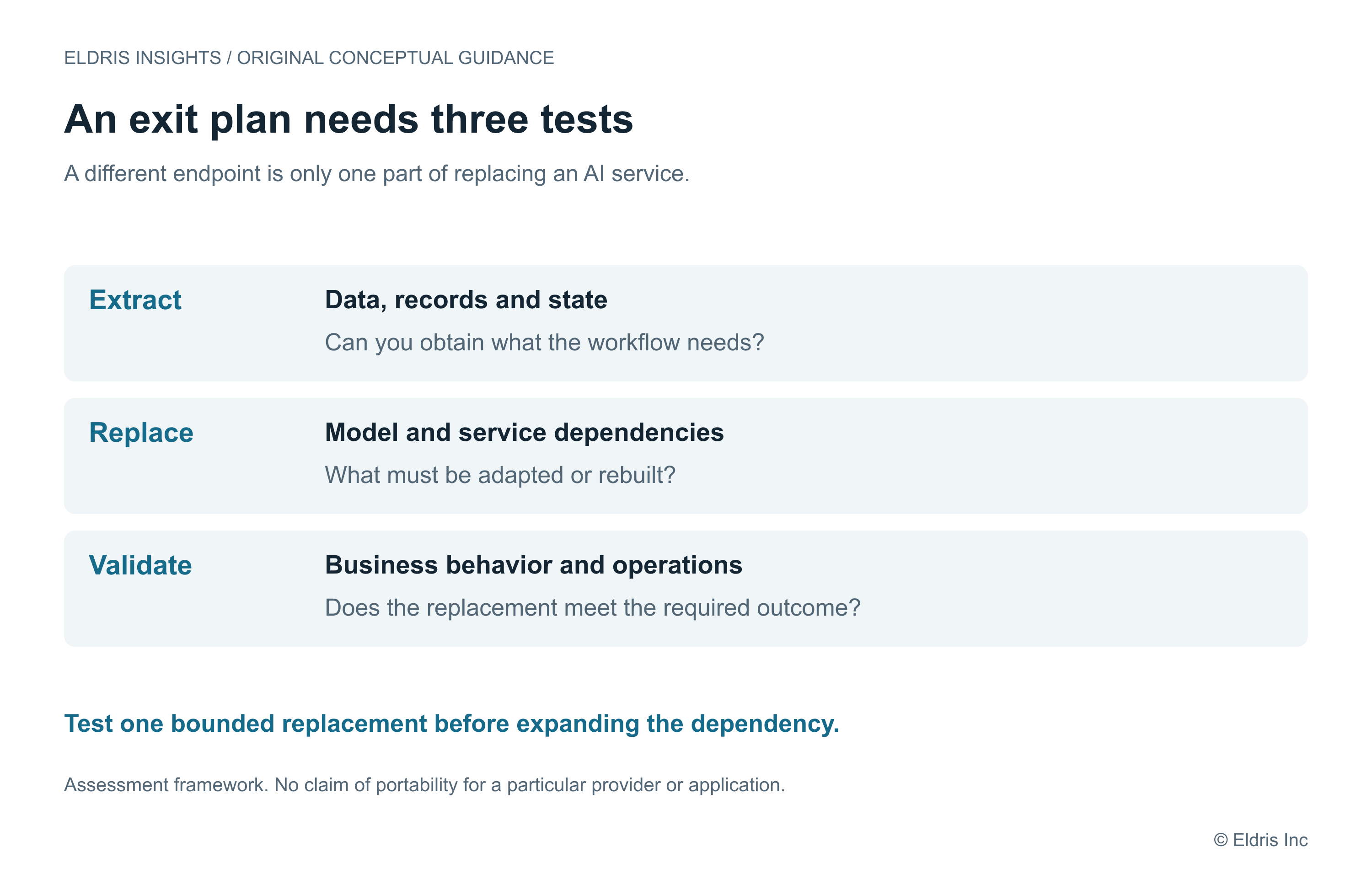
Original Eldris conceptual guidance. These tests frame an assessment; they do not establish that any particular provider or application is portable.
The strongest objection is that portability carries a cost. Restricting development to the features shared by every provider can sacrifice useful capability. Supporting multiple services may add complexity and dilute a team’s attention.
That objection is valid. An enterprise should not pay for elaborate optionality without a reason. A distinctive provider feature may deliver enough value to justify a deeper dependency.
The relevant question is whether management understands and accepts that commitment. What benefit does the feature provide? Which work would be needed to replace it? How much interruption could the business tolerate? What changes would make the relationship unattractive?
Sometimes the best answer is to use the specialized feature and fund a contingency. Sometimes it is to keep a critical workflow simpler. The judgment depends on the consequence of losing the service and the value of using it now.
Optionality is most valuable where a dependency would otherwise constrain a consequential decision. It is less valuable when replacement is easy or the workflow can be stopped without material harm.
Before a major expansion, select a bounded workflow and evaluate what a replacement would require. Use a credible alternative and record the work involved in configuration, adaptation, testing and restoring acceptable behavior.
The exercise need not establish instant failover or a fully maintained second service. It should answer the decision management is making. If the question is whether the business could change providers over a planned period, test that proposition. If continuity requires rapid substitution, the evidence and investment need to be stronger.
Include the people who own the workflow. A technical migration can succeed while employees lose a capability they depended on or reviewers face a much higher burden. Quality, operating effort and continuity belong in the result.
Use what the exercise reveals in procurement. Seek the information, export capabilities, service commitments and change provisions that address actual dependencies. Negotiate against a concrete operating need rather than asking for abstract assurances of flexibility.
For a multinational organization, test whether the alternative is usable in the receiving settings. A replacement that fits one unit may leave another with an unacceptable arrangement.
An exit exercise can support deeper commitment as well as caution. If switching is manageable and the current service delivers strong value, management has a better reason to expand. If the work is unexpectedly difficult, that is useful information before the dependency grows.
Choose the provider that deserves the work. Keep enough evidence and practical control to reconsider that choice. The ability to leave belongs in the economics from the beginning.
More insights
Apple silicon and unified memory made meaningful local model deployment practical inside a personal computer. That change enabled OOMU, and deserves a larger place in enterprise AI strategy.
An AI system can generate work faster than an organization can responsibly approve it. Leaders who promise human oversight need to fund and test the capacity behind that promise.
An assistant that presents itself as working for the customer should make commercial influence visible and let the customer define what a good purchase means.
The writing is the general case. An advisory engagement is the specific one.