
Apple Made Local AI a Software Decision
Apple silicon and unified memory made meaningful local model deployment practical inside a personal computer. That change enabled OOMU, and deserves a larger place in enterprise AI strategy.
Commentary
An assistant that presents itself as working for the customer should make commercial influence visible and let the customer define what a good purchase means.
Imagine telling an AI assistant that you need a laptop for basic office work and would prefer to spend less than your maximum budget. It returns one confident recommendation, explains why it suits you and offers to complete the purchase.
You do not see which suitable products were excluded. You do not know whether the seller pays the platform. You cannot tell whether the recommendation reflects your needs, the assistant’s available catalog or the economics of a completed sale.
This is a hypothetical scenario. It exposes a commercial question beneath the convenience: whose outcome is the assistant trying to improve?
My position is that a product marketed as a personal shopping assistant should make its commercial role explicit. It should let customers understand material limits on its advice and the influence of paid arrangements. It should also be capable of recommending that they buy nothing.
A product cannot reasonably ask for the authority of a personal adviser while concealing the incentives of a sales channel.
A shopping interface that lists several products gives the customer some opportunity to compare. A conversational assistant can instead compress the decision into a single answer.
That can save time. It also gives the system substantial influence over which alternatives receive attention and which tradeoffs are presented as important.
The product should establish what it is comparing. Does it search broadly, use a limited merchant network or recommend only items it can sell through its checkout? A limited catalog can still provide a useful service. The customer should know its boundary before interpreting the result as the best available choice.
Commercial relationships deserve the same clarity. A commission does not establish that a recommendation is bad. Nor does a subscription prove that advice is independent. The relevant questions are how the product makes its selection, which incentives affect it and whether the customer can understand those conditions.
A company should be able to explain why its recommendation serves the stated task without relying on the customer’s inability to inspect the choice.
The Federal Trade Commission’s native-advertising guidance emphasizes that promotional content should be recognizable as advertising and that necessary disclosures should be clear and prominent. That guidance concerns advertising; it does not by itself classify every assistant recommendation or resolve the obligations of a particular product. FTC, Native Advertising: A Guide for Businesses.
The product principle is useful here: a disclosure should give the customer a meaningful understanding of the relationship. A buried reference to partners cannot do all the work if the assistant presents a paid placement as an impartial recommendation.
Where payment affects placement, make that influence visible with the recommendation. Where the catalog is restricted, explain the restriction. Where the assistant lacks enough evidence to compare suitability, show the uncertainty rather than manufacturing confidence.
The test is whether the customer understands what kind of help they are receiving. A technically present label that people misunderstand is a weak foundation for an enduring service.
The strongest objection is that commercial relationships fund useful services. Merchant integrations can improve information, availability and the ability to complete a transaction. Removing them could make the assistant less convenient or more expensive.
I agree. A shopping assistant needs a viable business model, and integrated commerce can benefit the customer.
But funding the service and defining the customer’s objective are different decisions. A customer who asks for an inexpensive solution should not have to fight an assistant inclined to spend the full budget. Someone whose existing product remains adequate should be able to receive that advice.
The product should preserve the possibility of no purchase, a lower-cost choice or a merchant outside the easiest transaction path when those outcomes better fit the task. If it cannot evaluate those alternatives, it should say what it can evaluate.
This is a demanding position because it can put a good recommendation in tension with immediate revenue. That is precisely why it belongs in the strategy. An assistant’s promise of personal representation needs a business model that can tolerate the customer choosing differently.
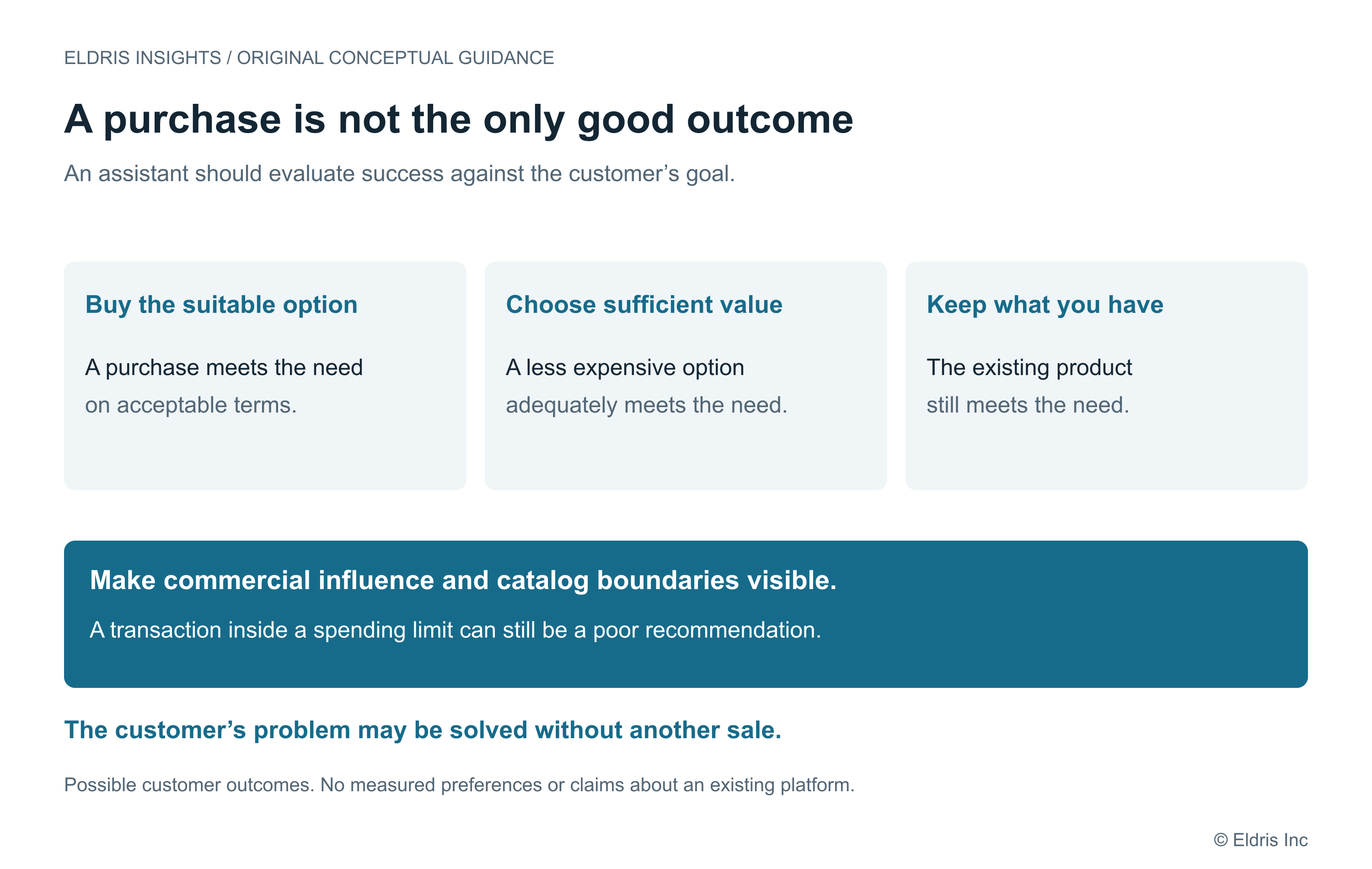
Original Eldris conceptual guidance. These are possible customer outcomes, not measured preferences or a prediction about any existing platform.
A spending ceiling can prevent an assistant from exceeding the amount authorized. It cannot establish that the purchase is useful or that the customer would prefer it to the alternatives.
An action can stay within its permission and still fail the customer’s goal. The assistant might select a more expensive item than necessary, ignore an important tradeoff or direct the purchase to a restricted set of sellers without explaining that limitation.
Product evaluation should therefore examine the recommendation and the transaction separately. Did the assistant respect the authority it received? Did its selection fit the customer’s stated needs? Did the customer understand the relevant commercial conditions?
Those questions also make research more useful. Teams can compare alternative designs for presenting paid placements, catalog boundaries and recommendations against a customer-defined objective. They should observe comprehension and choice, then test continued use. A purchase conversion rate alone cannot show whether the product kept its promise.
For consumer AI leaders, the choice is strategic. A merchant’s assistant can openly help customers choose among that merchant’s products. A discovery service can make paid placements visible. A personal purchasing assistant can offer a more demanding promise of helping across alternatives. Each proposition can be coherent if the customer understands it.
The difficulty begins when a product moves among those roles without telling the person using it. A warm conversational voice should not make the commercial relationship harder to identify.
The next product review should examine which outcomes the company rewards. Does the team measure whether the customer solved the problem, or primarily whether a transaction occurred? Can a recommendation to defer a purchase count as success? What happens when a customer’s best option generates less revenue?
Those answers shape the product more than another assurance that the assistant is trustworthy.
If you want customers to treat the assistant as being on their side, build a service that can put a good customer decision ahead of an immediate sale, and make its commercial boundaries clear.
More insights
Apple silicon and unified memory made meaningful local model deployment practical inside a personal computer. That change enabled OOMU, and deserves a larger place in enterprise AI strategy.
An AI system can generate work faster than an organization can responsibly approve it. Leaders who promise human oversight need to fund and test the capacity behind that promise.
A provider's attractive inference price can conceal an expensive dependency. Enterprise buyers should make the ability to change providers part of the original investment decision.
The writing is the general case. An advisory engagement is the specific one.