
Stop Asking Consumers to Trust AI. Give Them Power Over It.
Consumer AI companies should earn the right to act through permissions people can understand, limits the product enforces and remedies people can actually use.
Commentary
Foreign AI providers need a proposition that a U.S. buyer can approve, operate and defend. Technical superiority is one part of that proposition.
Imagine a foreign AI provider presenting its model to a U.S. enterprise. The demonstration is impressive. The provider shows strong results on the customer's task and offers an attractive price.
The buyer then asks who can access its data, who will investigate an incident, what happens if service is interrupted and how it can move to another provider.
The sales team returns to the model's performance.
This is a hypothetical exchange. It illustrates a strategic mistake: treating the buyer's approval questions as distractions from the product rather than part of the product the buyer is considering.
My position is that an international AI provider should design its U.S. market entry around the relationship customers must accept. A model can perform well while the surrounding offer remains difficult to approve.
Your buyer is choosing an operating dependency. A benchmark result cannot answer all the questions that dependency creates.
An enterprise adopting an AI service accepts more than an inference price and a set of capabilities. It accepts arrangements for data handling, access, updates, support, continuity and exit.
Those arrangements can affect the value of the investment. A low price is less persuasive if the customer must build its own exception process, fund additional oversight or maintain an expensive fallback. Strong performance is less useful if the proposed service cannot fit the buyer's permissions or operating requirements.
A provider should therefore be able to demonstrate the whole proposition for a specific use case. What information will the service receive? Who can access it? Which changes can the provider make? What can the customer control? Who responds when the service fails?
Some of those answers will differ by deployment arrangement. A managed service and a model operated within the customer's environment create different dependencies. Neither arrangement settles every approval question simply by existing.
NIST's AI Risk Management Framework explicitly addresses third-party software, data and other supply-chain risks under GOVERN 6. That is a useful reminder that the provider relationship belongs inside the assessment. It is not a nationality test or a guarantee that a particular arrangement is acceptable. NIST AI RMF Core.
Providers who want serious consideration should make these questions easy to answer. Asking the buyer to assemble the operating story from a model card, a sales presentation and several partners is a weak way to compete.
A prospective customer says it cannot use a foreign model. What should the provider conclude?
It needs to establish what the objection means. The buyer may have a binding restriction. It may object to a proposed data flow, to operational access, to an unfamiliar counterparty or to a dependency it cannot defend internally. It may also be using a broad label because nobody has examined the offer in detail.
These possibilities require different responses.
Model origin concerns where the model was developed and the organizations behind it. Hosting concerns where the proposed service runs and information is processed. Operational access concerns who can inspect, change or administer the system. Commercial accountability concerns the entity the customer relies on for commitments and remedies.
Those dimensions can overlap, but one cannot stand in for all the others. U.S. hosting does not, by itself, establish who has access or which company controls the service. A familiar reseller does not automatically resolve an objection to the underlying model. A customer-operated deployment may change data flows while leaving other concerns unanswered.
The provider's job is to describe the arrangement accurately and identify the objection it addresses. It should resist selling a change in one dimension as a universal answer to concerns in another.
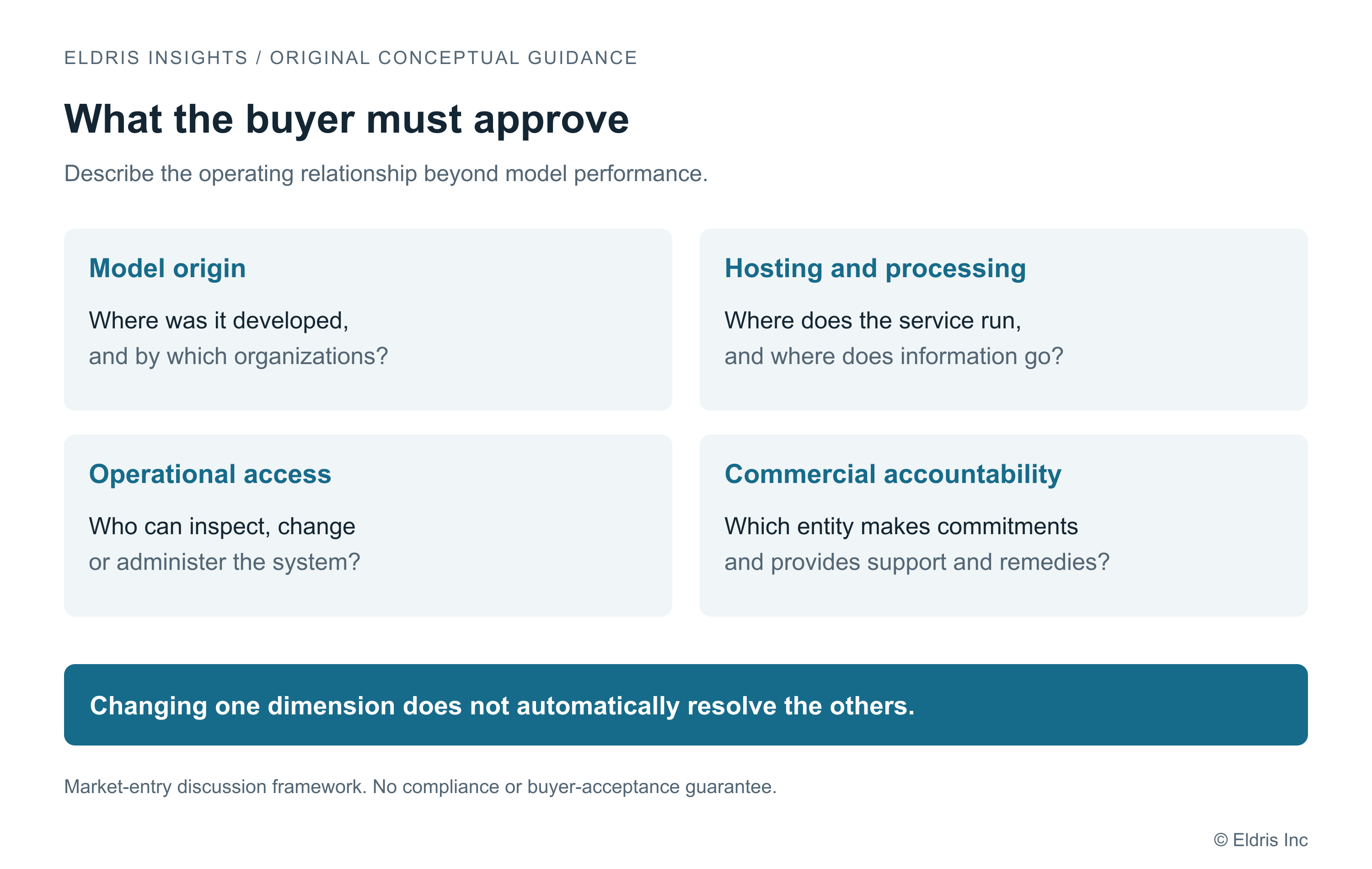
Original Eldris conceptual guidance. These dimensions support market-entry analysis; they are not a compliance checklist or a prediction of buyer acceptance.
The strongest objection is that this argument places too much responsibility on the provider. Buyers can be unfair. Nationality can become a shortcut for suspicion, and a technically inferior incumbent can benefit from familiarity.
That is a legitimate concern. A buyer should distinguish evidence from assumption and explain the conditions under which an offer could be considered. Procurement deserves scrutiny as well as suppliers.
But a provider cannot build a market-entry plan on the expectation that customers will become fairer. It needs to discover where an acceptable commercial relationship is possible and what it would cost to establish one.
Some segments may remain inaccessible because of binding restrictions or conditions the provider cannot satisfy. Others may be accessible only through an operating arrangement that destroys the proposed economics. Those findings should change the target market.
The choice to pursue a narrower buyer segment can be strategically sound. A provider should seek customers whose tasks, requirements and approval processes fit an offer it can actually deliver. Winning an evaluation that cannot lead to a viable deployment is an expensive form of encouragement.
Market-entry research should establish the decision a provider needs to influence. A customer's willingness to try a model is different from willingness to approve it for a particular workflow, pay for it and depend on it.
Start with a bounded task and a defined buyer population. Keep demonstrated capability consistent when examining objections to origin, hosting or assurance, and describe the conditions precisely. A preference for a vaguely described domestic alternative tells the provider little about which changes would earn approval.
Then test the proposed responses. Would a different deployment arrangement address the concern? Would clearer operational access controls matter? Does the buyer require a support commitment, an exit plan or evidence the provider has not supplied?
Research should also allow the answer to be “none of these changes would be sufficient.” That is commercially useful information. It can prevent investment in a reassurance campaign aimed at customers who cannot or will not purchase.
Stated willingness still needs validation through the actual approval and purchasing process. A favorable survey response cannot establish that an enterprise will sign a contract. The value of the research is to distinguish promising propositions from assumptions that deserve to be tested before expensive commitments.
For an international provider, U.S. entry should begin with a clear account of the task, target buyer, deployment arrangement and operating relationship. The company should identify which objections it can address, what evidence it will supply and where the cost of doing so undermines the opportunity.
A technical advantage remains important. Buyers should demand one that matters for their work rather than accepting familiarity as sufficient reason to choose an incumbent. The challenger, in turn, should make its advantage usable within a credible service.
The practical test is whether the buyer's internal sponsor can explain the decision to the people who must approve and operate it. That sponsor needs a defensible account of value, dependencies and responsibilities. Giving them a better benchmark is helpful. Giving them an approvable proposition is the market-entry work.
If your U.S. strategy ends at proving the model is better, you have demonstrated a capability. You still have to build the business that a customer can say yes to.
More insights
Consumer AI companies should earn the right to act through permissions people can understand, limits the product enforces and remedies people can actually use.
Employers who want employees to reveal and help realize AI productivity gains should make a credible bargain about what happens next.
Executives should be willing to expand a few valuable applications and close many others. A strategy that cannot stop an AI project cannot allocate capital seriously.
The writing is the general case. An advisory engagement is the specific one.