
A Better Model Does Not Entitle You to the U.S. Market
Foreign AI providers need a proposition that a U.S. buyer can approve, operate and defend. Technical superiority is one part of that proposition.
Commentary
Employers who want employees to reveal and help realize AI productivity gains should make a credible bargain about what happens next.
Imagine an analyst who finds an approved way to use AI to prepare a recurring report faster. She checks the result, corrects the mistakes and delivers the same quality of work in less time.
Should she tell her manager how much time she saved?
The answer depends on what she expects the manager to do with that information. Recognition and more interesting work would make disclosure attractive. A permanently higher target, without additional support or reward, would make it less attractive. If she thinks the discovery will help eliminate her role, enthusiasm becomes a difficult thing to ask of her.
This is a hypothetical example. It illustrates an incentive problem that an adoption campaign cannot settle by telling people to embrace the future.
My position is that employers should establish the terms of productivity improvement before asking employees to help expose its full potential. They should explain how gains will affect workload, rewards, development and job redesign, and give employees a meaningful role in that process.
You cannot reasonably ask people to reveal where their work can be compressed while treating their interest in the consequences as an obstacle to innovation.
The obvious objection is that the employer pays for the tools, the employee's time and the work itself. Management has a legitimate interest in using improved methods to produce more value.
I agree. The argument here concerns management judgment and cooperation. The title is not a claim about legal ownership, contractual duties or a right to conceal work. Employees should meet their responsibilities, follow policies and protect company information.
But access to a tool does not give management an accurate account of how the work can be redesigned. Employees know where a draft needs correction, which shortcuts create downstream problems and which apparent time savings depend on experience that a less skilled user may lack.
Discovering that information requires cooperation beyond clicking through a training course. A company may need people to experiment carefully, document what they learn, identify weaknesses and teach others how to use the method. Those contributions take time and judgment.
The employer's investment deserves a return. Employees' cooperation deserves a credible account of what that return will mean for them. A business that neglects the second question may struggle to answer the first.
In the analyst's example, the immediate gain is faster preparation. Management still has to decide what to do with the available capacity.
It could use it to improve analysis, reduce delays, accommodate more work or develop the employee's skills. It could also revise staffing. Those outcomes are management choices, and employees have reasons to care which choices are being considered.
Suppose every improvement leads to a higher target, while the target never falls when the work becomes more difficult. An employee could reasonably conclude that sharing a gain creates a permanent obligation based on a temporary advantage.
That possibility deserves attention before a leader describes reluctance as resistance. The employee may be uncertain about the tool. She may also understand the organization's incentives very well.
An executive who wants honest evidence should examine how managers respond to it. If the first reported saving becomes an immediate performance requirement, without checking quality, task differences or sustainability, the organization has created a reason to be cautious about the next report.
Productivity evidence also needs nuance. Brynjolfsson, Li and Raymond's published study of AI-assisted customer support found that benefits differed substantially across workers, with larger gains among less experienced and lower-skilled agents. A result from that setting cannot establish a universal target for another workforce. Generative AI at Work, The Quarterly Journal of Economics.
Management should avoid converting one person's successful technique into everyone's new obligation before establishing what makes it work.
A promise that “AI will free you for higher-value work” leaves the employee with several unanswered questions. Which work? Who chooses it? Will there be time to learn? Does the existing workload change, or does the new work arrive on top of it?
A credible bargain answers those questions within the scope of the deployment.
It might provide paid time for experimentation and training, recognition for validated improvements, opportunities to help redesign the process and a stated approach to reviewing workload changes. Where appropriate, it could include financial rewards or a defined share of benefits. No single arrangement fits every organization.
The commitment should be concrete enough to evaluate. If employees are promised development opportunities, name the opportunities and allocate time. If a gain is supposed to reduce an unreasonable burden, explain which burden will change. If management intends to use the improvement to increase throughput, say so and establish how quality and workload will be assessed.
Employees should also know how to report a method that fails. Useful cooperation includes discovering that an assistant introduces unacceptable errors or creates more review work than it saves. Rewarding only favorable findings compromises the evidence management needs.
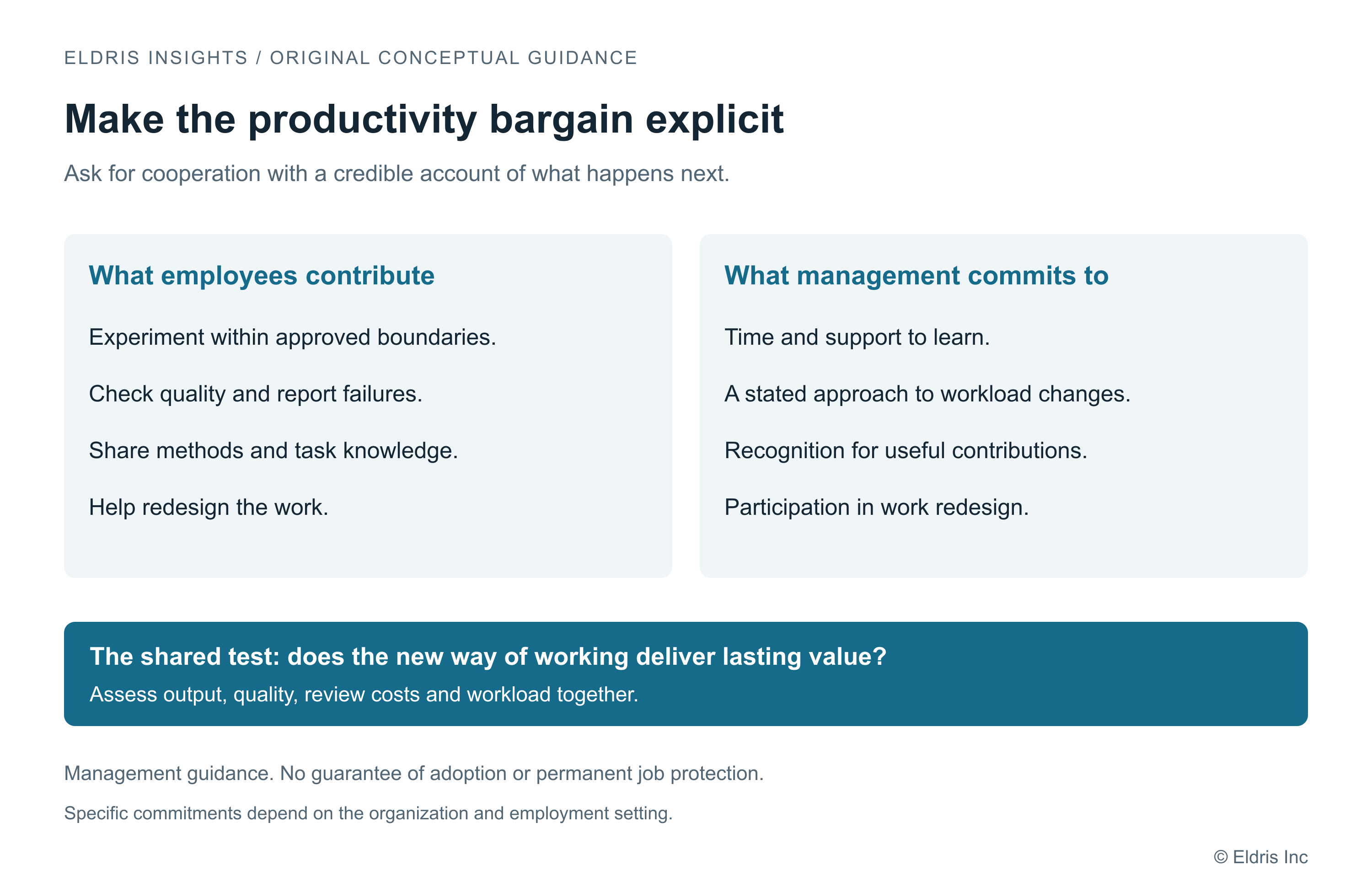
Original Eldris conceptual guidance. The commitments illustrate a management proposal, not a legal entitlement, validated incentive model or guarantee of employee behavior.
The difficult objection is that management may be unable to guarantee jobs or future workloads. Competition, demand and technological change can affect what the organization needs.
A credible bargain should acknowledge that uncertainty. It should not promise permanent protection that leadership cannot deliver.
It can still specify how decisions will be made, what employees will be told and which support the organization is prepared to fund. If staffing changes are under consideration, assurances that the project is purely about empowerment are a poor foundation for cooperation.
Employees may disagree with a decision even when the process is clear. Transparency cannot guarantee enthusiasm. But leaders should prefer an honest disagreement to participation obtained through an assurance that later proves hollow.
For a multinational company, the arrangements may differ across business units and employment settings. The principle can remain consistent: people should understand the terms on which they are being asked to help transform their work. Local leaders need authority and resources to deliver the commitments they make.
Before approving an AI rollout, executives should require an account of how the organization will obtain and sustain employee cooperation.
That account should include time for learning, support for correcting mistakes, the treatment of reported improvements and the process for changing expectations. These commitments consume resources. They belong in the economics of the deployment.
Leaders should then evaluate actual outcomes: whether employees use the approved method, whether work improves, whether review costs rise and whether the gains persist. Participation and disclosure are useful evidence, but they cannot substitute for an assessment of business value.
The management challenge is to create terms under which helping the organization improve is a reasonable choice for the people doing the work.
If the company wants employees to help discover the value of AI, it should be prepared to tell them how they will participate in the value they help create.
More insights
Foreign AI providers need a proposition that a U.S. buyer can approve, operate and defend. Technical superiority is one part of that proposition.
Consumer AI companies should earn the right to act through permissions people can understand, limits the product enforces and remedies people can actually use.
Executives should be willing to expand a few valuable applications and close many others. A strategy that cannot stop an AI project cannot allocate capital seriously.
The writing is the general case. An advisory engagement is the specific one.