
A Better Model Does Not Entitle You to the U.S. Market
Foreign AI providers need a proposition that a U.S. buyer can approve, operate and defend. Technical superiority is one part of that proposition.
Commentary
Executives should be willing to expand a few valuable applications and close many others. A strategy that cannot stop an AI project cannot allocate capital seriously.
Imagine an executive reviewing an AI portfolio. Every department has a project. Every project has a sponsor. The presentation shows more users, more activity and more initiatives than the previous quarter.
Then someone asks which applications should be closed.
The conversation changes. Teams need more time. Employees are still learning. The next model could improve performance. Closing a project might send the wrong signal about innovation.
This is a hypothetical scene, but the management choice is real: what should count as progress when an organization is investing in AI?
My position is that a good strategy should make the organization more willing to stop an application. It should also make leaders more confident about expanding the applications that deserve resources. The resulting portfolio may contain less AI, even as the business gets more value from it.
An executive who can authorize AI but cannot withdraw its funding has a spending program with an incomplete decision process.
An adoption target gives teams a visible objective. It can help during a rollout, when an organization needs to establish whether employees can access and use a tool. Usage can also reveal demand worth investigating.
But a usage measure acquires strategic meaning only when it connects to an outcome the business wants.
Suppose an assistant helps employees prepare internal updates. They use it frequently. The updates become longer, managers spend more time reading them and the underlying decisions arrive no sooner. In that hypothetical case, increased use would offer little reason to celebrate the investment.
Another application might serve a small specialist team and remove a consequential delay from a valuable process. Its user count could remain modest while its business contribution grows.
A portfolio governed by activity would struggle to compare those applications sensibly. The executive needs to know which process improves, who benefits and what the organization must spend to sustain the improvement.
That spending includes the surrounding work: review, correction, support, integration and changes to the process. The comparison should also include credible alternatives. Sometimes a better form, clearer instructions or a revised approval rule can address the problem. An AI proposal should be able to explain why its chosen approach deserves the investment.
The strategic question is how to improve the business. The amount of AI used is a consequence of the answer.
A project sponsor asked to demonstrate success has a reason to emphasize encouraging results. If closing the project carries reputational cost, the review process asks that sponsor to make a personally difficult recommendation.
Leaders should change that bargain. A team that establishes an application is uneconomic, poorly suited to the task or unnecessary has delivered useful information. Its work can prevent a larger commitment and free resources for another opportunity.
That does not mean celebrating careless execution. Managers should distinguish a weak idea tested competently from a promising idea tested badly. A failed evaluation can require better evidence. A convincing negative result can justify ending the investment.
The distinction belongs in the funding agreement from the beginning. What will the team learn? What evidence would support expansion? What finding would justify closing or narrowing the application? Who will make that decision?
Without answers, “another quarter” can become the default recommendation. Continued funding then reflects the difficulty of stopping rather than the strength of the opportunity.
Executives should reward the quality of the decision a team enables. Otherwise, they should expect a portfolio in which projects repeatedly discover reasons to survive.
The strongest objection is that strict commercial tests could extinguish experimentation. Early work may create knowledge, skills and future options whose value cannot be expressed in immediate returns.
I agree. An organization that funds only applications with established benefits would constrain its ability to discover new ones.
The answer is to give exploration an explicit budget and purpose. A team can receive funding to determine whether a workflow is technically feasible, whether users want it or whether a particular dependency can be resolved. The experiment should have a bounded commitment, a decision it informs and a date for review.
Learning can be the intended return. The team should specify what it will learn well enough that a leader can judge whether the next experiment is worthwhile.
An operating service has a different funding claim. It asks the organization to support ongoing use. That claim needs evidence about the outcome, the resources required and the people responsible for delivering it.
Moving from exploration to operation should therefore require a new decision. Keeping an experiment available indefinitely can create continuing obligations without anyone explicitly accepting them.
This discipline preserves room for ambition. It makes the cost of uncertainty visible and allows leaders to choose how much of it to fund.
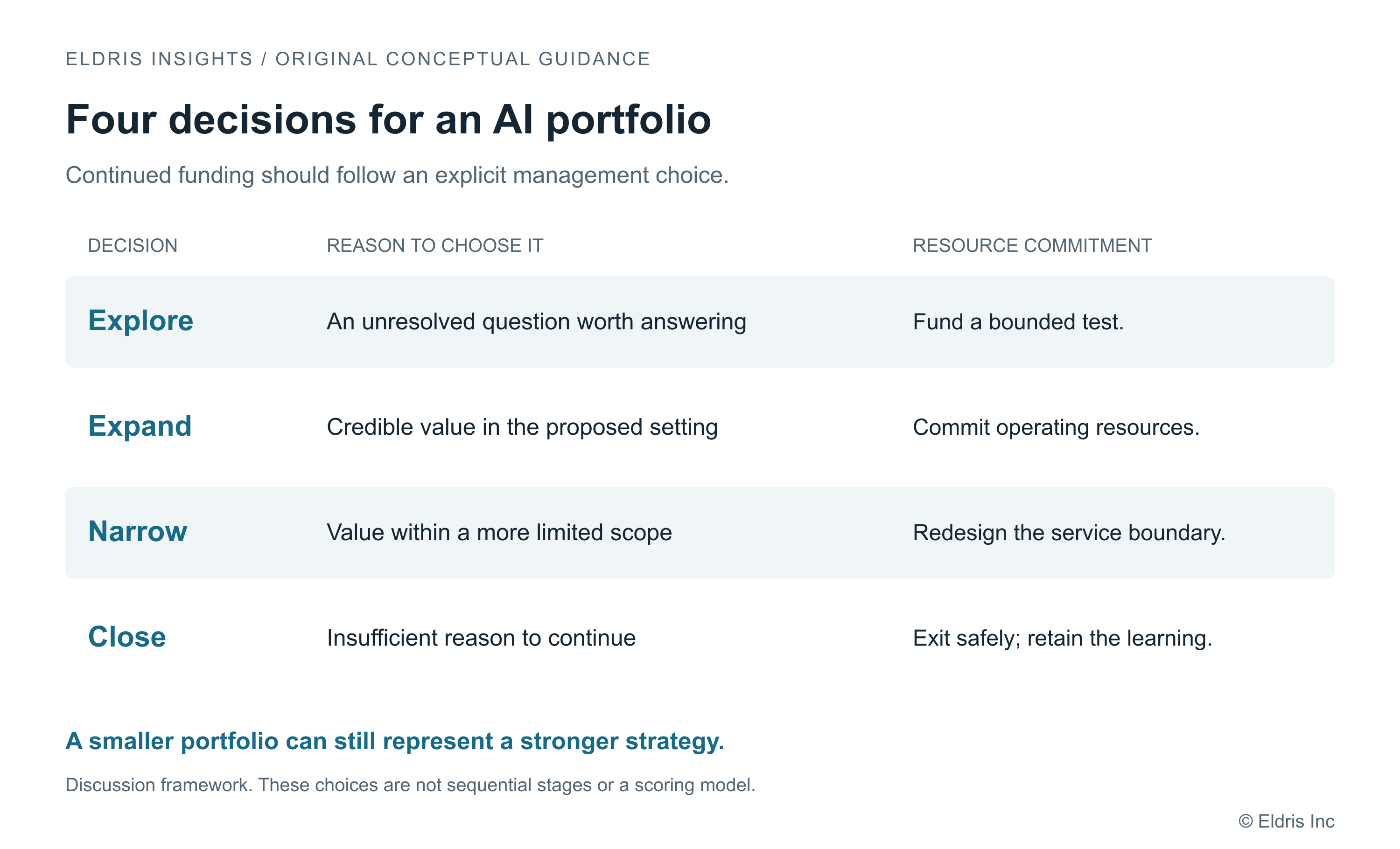
Original Eldris conceptual guidance. These are management choices, not a scoring model. The evidence required depends on the application and the consequences of the decision.
At the next portfolio review, give every application a credible path to one of four outcomes: further exploration, expansion, narrower scope or closure.
Further exploration requires an unresolved question that matters and a proportionate plan to answer it. A team should explain what another round of work could change about the decision.
Expansion requires a reason to believe the application delivers a worthwhile outcome under the conditions being proposed. A valuable application in one team may need further testing before reaching a different workflow or business unit.
Narrowing can preserve value while reducing cost or exposure. An assistant might be useful for preparing a recommendation but unsuitable for making the final commitment. A service might work well for one category of requests and poorly for another. Those findings should shape its scope.
Closure requires a plan as well. People may depend on the application, and work may need to move to another process. NIST's AI Risk Management Framework explicitly includes safe decommissioning and phasing out of AI systems under GOVERN 1.7. Ending a service deserves operational attention. NIST AI RMF Core.
The review should expose the choices management is making. Money spent extending one experiment cannot also fund another. Staff assigned to maintain a marginal service cannot spend the same time improving a more valuable workflow. A portfolio becomes a strategy when leaders confront those tradeoffs.
For a multinational enterprise, this judgment also needs room for local differences. A useful application in one business unit does not establish a mandate for all of them. Leaders should test whether the task, economics and operating conditions justify expansion in each receiving setting.
The board should receive an account of what the organization chose to expand, what it narrowed, what it closed and what uncertainty it is still paying to resolve. Adoption figures can help explain that account. They cannot substitute for it.
The test of an AI strategy is whether it helps leaders allocate resources to worthwhile outcomes. Sometimes that means wider deployment. Sometimes it means a smaller, better supported set of applications.
If your next portfolio review produces fewer AI projects and stronger reasons for funding the remaining ones, you may finally be making strategic progress.
More insights
Foreign AI providers need a proposition that a U.S. buyer can approve, operate and defend. Technical superiority is one part of that proposition.
Consumer AI companies should earn the right to act through permissions people can understand, limits the product enforces and remedies people can actually use.
Employers who want employees to reveal and help realize AI productivity gains should make a credible bargain about what happens next.
The writing is the general case. An advisory engagement is the specific one.