
A Better Model Does Not Entitle You to the U.S. Market
Foreign AI providers need a proposition that a U.S. buyer can approve, operate and defend. Technical superiority is one part of that proposition.
Commentary
Consumer AI companies should earn the right to act through permissions people can understand, limits the product enforces and remedies people can actually use.
Imagine asking an AI assistant to find a replacement coffee maker. It compares prices, identifies a suitable model and explains the tradeoffs. You like the recommendation.
Then it asks for permission to shop for you in the future.
What are you agreeing to? Can it choose another brand? Buy from an unfamiliar seller? Pay for expedited shipping? Accept a subscription discount? How do you stop it, and what happens if it buys the wrong thing?
This is a hypothetical shopping scenario. The ambiguity is the point. Confidence in a recommendation does not settle how much authority you want to give the recommender.
My position is that consumer AI companies should spend less effort asking people to become comfortable with AI and more effort making the authority they grant understandable and enforceable. A consumer should be able to delegate a task without signing up for an undefined relationship with an increasingly capable system.
If your growth strategy requires people to become less cautious about what your assistant can do, examine the product before blaming the consumer.
An assistant can deserve permission to research a purchase and still lack permission to complete it. It can earn authority to reorder one household item without earning authority to buy its replacements, add accessories or choose a different merchant.
Those distinctions should survive contact with the interface.
A broad instruction such as “handle my shopping” leaves important choices unresolved. The product team must decide which conditions it will establish with the customer and what the assistant will do when a choice falls outside them.
For the coffee maker, a useful agreement might specify the model, approved seller, maximum total charge and whether the assistant can complete the purchase without another confirmation. A standing replenishment instruction would need its own scope and duration. Neither should silently become permission to manage the rest of the household budget.
Consumers do not need to study an agent's architecture to make these choices. They need to understand the commitment being offered. Finding, recommending and purchasing should have meanings that remain stable as the service develops.
That stability is a commercial responsibility. A product that quietly expands what an existing permission allows asks the customer to bear the consequences of the company's ambition.
It is easy to write a reassuring instruction: “Never spend more than $100.” The harder question is whether the system will enforce it at the point of action.
Does that limit include tax, delivery charges and other fees? Does it apply to one transaction or a series of purchases? What happens when a price changes between the recommendation and checkout?
The assistant should not be able to talk its way past a boundary because it decides the customer would probably approve. Product teams should treat consequential limits as constraints on execution, with an explicit path back to the consumer when an exception is needed.
This approach already appears in commercial infrastructure proposals. Visa's April 30, 2025 announcement of Intelligent Commerce described spending limits and conditions for agent transactions. That is evidence of an industry design direction, not proof that any particular control increases adoption or works well in every product. Visa's announcement.
The strategic opportunity is to make those boundaries part of the experience people choose the product for. “It stays within the authority I gave it” should be as central to the value proposition as “it saves me time.”
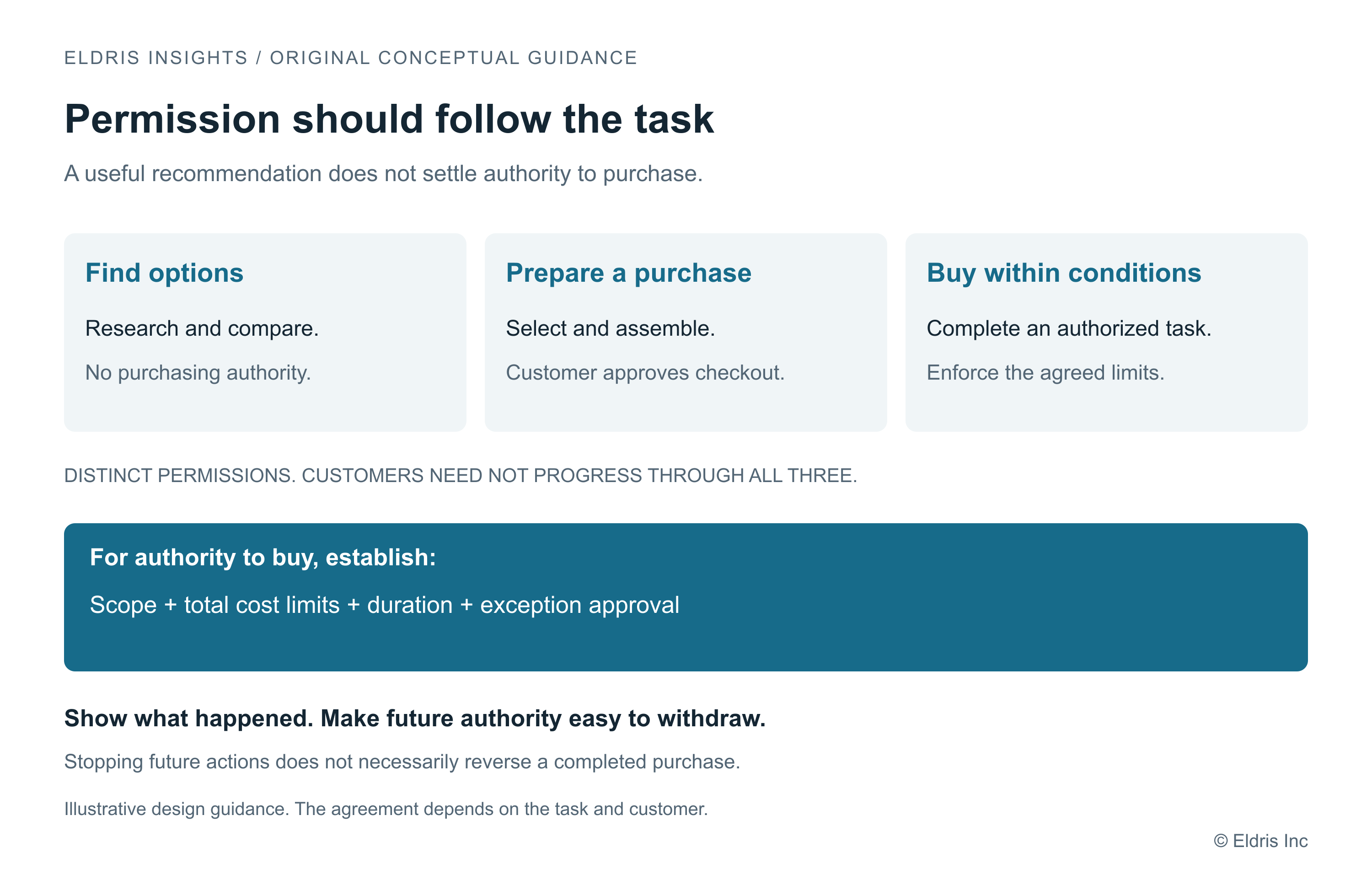
Original Eldris conceptual guidance. The stages illustrate different grants of authority; they are not a requirement that every customer progress to autonomous purchasing.
The strongest objection is obvious. If customers must approve every detail, the assistant has given them another interface to manage. The promised convenience disappears.
That objection should shape the design. Good control lets people make a meaningful choice once and rely on it within an agreed scope. It does not demand a ceremonial click for every minor step.
For a familiar replenishment task, a customer might authorize purchases from an approved seller below a total price ceiling for a stated period. The assistant can then act within those conditions. A changed product, unexpected commitment or charge outside the limit should return the decision to the customer.
For an unfamiliar, expensive or difficult-to-reverse purchase, approval at checkout may remain part of the service. The product can still save substantial work by researching options and preparing the transaction.
The right amount of autonomy depends on what the customer wants to delegate and what a mistake would mean. A team should test whether people understand the permission, whether the resulting actions match their intent and whether they continue using the service. Fewer confirmation screens alone cannot establish a better experience.
Bounded delegation is a valuable product outcome. Maximum autonomy should not be the presumed destination for every customer.
An authorization design is incomplete until the customer can change their mind.
Withdrawal should be easy to find and specific about its effect. Does it stop future purchases? Cancel queued actions? Disconnect a payment credential? The customer should not have to infer the answer from a generic “assistant disabled” message.
The product must also distinguish stopping future actions from reversing completed ones. Revoking permission cannot necessarily undo an order already submitted or a commitment already made. A useful interface should show what has happened, what can still be stopped and which cancellation or remedy process applies.
This is where a claim of consumer control becomes concrete. A reassuring setting is insufficient if the customer cannot establish the status of an action or reach someone who can resolve a problem.
Records should help the customer understand the decision: what was authorized, what the assistant did, what was charged and whether an exception occurred. Recourse should identify a usable route to assistance. It should not send the person through a chain of providers, each describing the mistake as someone else's responsibility.
The commercial promise needs to survive a bad purchase as well as a successful one.
For consumer AI leaders, the next adoption question should be concrete: which task will someone let this product complete, under which conditions, and what would make them withdraw that permission?
That question can inform product design, positioning and research. Compare a small number of meaningful permission arrangements. Observe whether users recognize the boundaries and can change them. Include exceptions and withdrawal in the evaluation. A positive reaction to the assistant's tone is not enough to establish that its authority is understood.
Brand confidence still matters. So do capability, price and convenience. Controls cannot compensate for a product that performs the task badly. But capable products should compete on the quality of the delegation relationship they offer.
The company that deserves more authority is the one that makes limited authority useful, honors its boundaries and lets the customer take it back.
More insights
Foreign AI providers need a proposition that a U.S. buyer can approve, operate and defend. Technical superiority is one part of that proposition.
Employers who want employees to reveal and help realize AI productivity gains should make a credible bargain about what happens next.
Executives should be willing to expand a few valuable applications and close many others. A strategy that cannot stop an AI project cannot allocate capital seriously.
The writing is the general case. An advisory engagement is the specific one.